
MOQ Explained: Minimum Order Quantities for Custom Furniture from China
Last Updated: August 2026
Introduction
A first-time furniture importer in California found the perfect supplier for her boutique hotel project. The factory’s catalog was stunning, the quality looked excellent, and the price was well within budget. She was ready to place an order — until she saw the MOQ: 300 pieces per design.
She only needed 60 chairs across three different models. The supplier wouldn’t budge. The project was delayed by four months while she searched for a factory that could accommodate her volume.
This scenario plays out every day in the furniture sourcing world. MOQ — Minimum Order Quantity — is one of the most critical and misunderstood terms in B2B furniture procurement. It determines not only how much you must buy, but also your unit cost, cash flow requirements, risk exposure, and which suppliers you can work with.
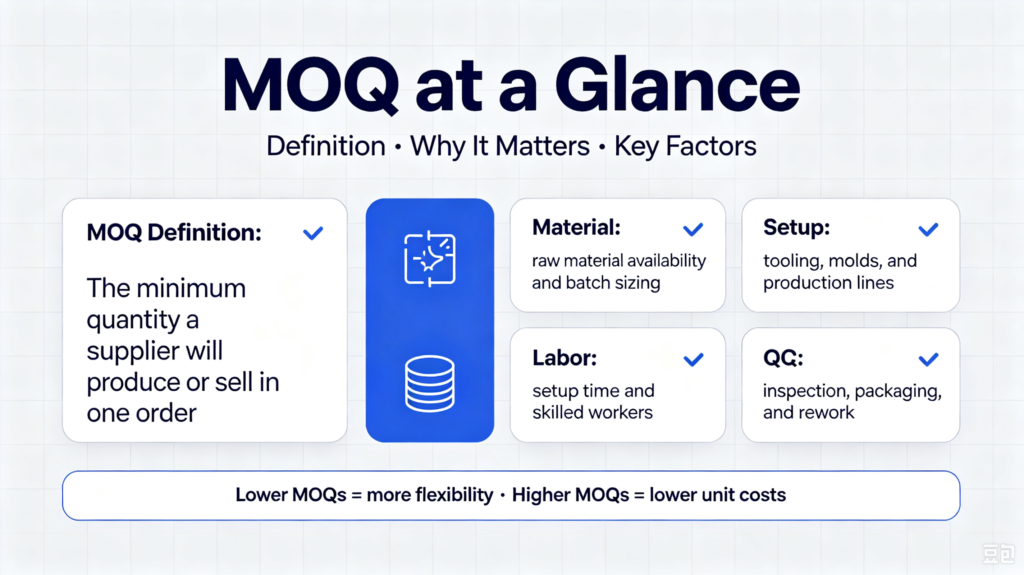
MOQ, short for “Minimum Order Quantity,” refers to the minimum quantity or amount of products that a supplier requires a buyer to purchase in a single order to cover costs such as production, materials, and labor. In the furniture industry, MOQ is not a uniform standard — it varies significantly depending on product type, material, and production process.
This guide explains everything B2B furniture buyers need to know about MOQs: what drives them, what to expect across different product categories and customization levels, and — most importantly — how to negotiate them to your advantage.
1. What Drives MOQ in Furniture Manufacturing?
Understanding why factories set MOQs helps you negotiate more effectively. MOQs exist because furniture production involves significant fixed costs that must be spread across units.
The Economics Behind MOQ
Material procurement: Factories buy raw materials in bulk — fabric rolls, foam sheets, wood panels, steel coils, hardware. If a buyer orders 50 chairs but the factory must purchase 200 meters of custom-colored fabric (minimum from the textile supplier), the extra material cost must be absorbed somewhere. Factories protect themselves by setting MOQs that justify material purchases.
Production setup: Every production run requires setup time — cutting patterns, calibrating machines, training workers on assembly steps. For a custom design, the factory may need to create new jigs, cutting patterns, or component molds. These setup costs are fixed regardless of order size. A 50-unit order and a 500-unit order may require the same setup time, so the factory needs enough units to make the setup economically viable.
Labor allocation: Production lines have minimum efficient scales. Running a line for 10 chairs takes nearly as much labor as running it for 100 chairs — the workers are there, the machines are running, the overhead is the same.
Quality control investment: Establishing QC protocols, training inspectors, and conducting first-article inspections all cost time and money. Factories need sufficient volume to justify this investment.
Inventory and cash flow: Factories must commit capital to materials and production before receiving payment. MOQs ensure that each order generates enough revenue to cover these costs and contribute to profitability.
The Scale Effect
A factory quoting $780 per sofa at a 50-unit MOQ will typically quote $920–1,050 for a 10-unit order of the same specification — because the fixed costs (material procurement, cutting setup, quality inspection) are distributed across fewer units. A $100–270 per unit premium for smaller orders is not arbitrary — it reflects the real cost of inefficiency.
Key takeaway: MOQ is not a punishment for small buyers. It is a factory’s way of ensuring that your order covers their costs. Understanding this makes negotiations more productive.
2. Customization Tiers and Their MOQ Requirements
Not all “custom” orders are the same. The level of customization you request directly determines the MOQ a factory will require. Understanding these tiers is the first step to realistic MOQ expectations.
Tier 1: Stock Modification
What changes: Fabric, finish, color, hardware only. The factory’s existing design, dimensions, and construction remain unchanged.
Typical MOQ: Same as stock — often 1–10 pieces. Some factories accept as low as 1–5 pieces for sampling or small retail batches.
Cost premium: Minimal — material cost difference only
Example: You select an existing dining chair from the factory’s catalog and request it in your brand’s signature velvet fabric instead of the standard linen. The factory orders the fabric from their supplier and produces your chairs.
Who this works for: Startups testing new markets, small retailers, boutique brands, e-commerce sellers.
Tier 2: Design Adaptation
What changes: Dimensions, leg style, structural changes within existing construction.
Typical MOQ: 20–50 pieces, depending on product category
Cost premium: 5–15% depending on complexity
Example: You like a factory’s standard sofa design but need it 20cm shorter to fit your target market’s smaller apartments. The factory adjusts the frame dimensions, creates a new cutting pattern, and produces a sample for your approval.
Who this works for: Brands with specific size requirements, hospitality projects, retailers targeting specific demographics.
Tier 3: OEM / Fully Custom
What changes: New design from buyer drawings or reference samples
Typical MOQ: 50–200+ pieces, depending on product category
Cost premium: 15–30%+ plus potential tooling cost
Example: You provide CAD drawings for a completely original coffee table design. The factory creates new jigs and cutting patterns, sources new materials, and produces a prototype from scratch.
Who this works for: Established brands with design capability, large retailers, hotel chains, buyers with high-volume requirements.
Key Insight
Most buyers overestimate how simple Tier 3 is and underestimate how capable factories are at Tier 2 when the right specification is provided upfront. If you can achieve your goals through design adaptation (Tier 2) rather than full custom (Tier 3), you can significantly reduce your MOQ and time-to-market.
3. MOQ by Product Category
MOQs vary significantly across different furniture categories. Here is what you can typically expect:
Important nuance: Some suppliers accept cubic-meter-based orders (e.g., 1m³), enabling mixed-product containers for diversified portfolios. This is particularly valuable for buyers who want to test multiple SKUs without committing to high MOQs per SKU.
A Foshan upholstery factory serving Wayfair operates a Make-to-Stock (MTS) model for sofa frames, spring hardware, and foam cushions. When overseas designers place orders, the facility only cuts and upholsters bespoke fabrics under an Assemble-to-Order (ATO) model. This setup lowers MOQ to just 20 units for initial production runs. With core structural components kept in stock, the factory can fulfill bulk repeat orders of hundreds of pieces and ship them within 14 days.
4. MOQ by Business Model
Different factory types have different MOQ structures. Understanding these helps you target the right suppliers for your volume needs.
Manufacturer (Factory)
Typical MOQ: 50–200+ units per SKU, depending on customization level
Pros: Lowest per-unit pricing, full customization capability, direct quality control
Cons: Higher MOQs, less flexibility for small orders
Best for: Large-volume buyers, established brands, recurring orders
Trading Company
Typical MOQ: 10–50 units per SKU; often supports mixed batches
Pros: Lower MOQs, access to multiple factories, single point of contact
Cons: Higher per-unit pricing (15–30% markup), less production transparency
Best for: First-time importers, small-to-medium buyers, multi-category sourcing
Hybrid (Manufacturer-Trader)
Typical MOQ: 20–100 units; flexible depending on product
Pros: Balance of factory-direct pricing and MOQ flexibility
Cons: May subcontract part of your order without telling you
Best for: Buyers who need some flexibility but want better pricing than a pure trading company
5. MOQ vs. Unit Price: The Trade-Off
The relationship between MOQ and unit price is straightforward: higher volume = lower per-unit cost. But the relationship is not linear — there are diminishing returns.
Typical Pricing Tiers
For a dining chair with a base MOQ of 50 units at $50/unit:
| Order Quantity | Approximate Unit Price | Savings |
|---|---|---|
| 10 units | $65–70 | — |
| 50 units (base MOQ) | $50 | 23–29% vs. 10 units |
| 100 units | $44–46 | 34–37% vs. 10 units |
| 200 units | $40–42 | 40–42% vs. 10 units |
| 500 units | $37–39 | 45–47% vs. 10 units |
The steepest savings occur between the minimum viable order (10–20 units) and the base MOQ (50 units). Beyond 200 units, savings per additional unit diminish significantly.
Negotiation Leverage
A factory will often accept a lower quantity for a new buyer if the unit price compensates for the smaller run. In practice:
- For a 10-unit order, expect to pay a 15–30% premium over the MOQ price
- For a 30-unit order, the premium may be 10–15%
- For a 50-unit order, you are at or near the MOQ and paying the base price
The trade-off: If you are ordering 30 units, paying a 15% premium might still be cheaper than ordering 50 units you cannot sell. Calculate the total cost, not just the unit price.
6. How to Negotiate MOQ
MOQ is not set in stone. Most furniture suppliers are willing to negotiate — especially for new customers, trial orders, or buyers with long-term potential. Here is how to approach the negotiation.
Strategy 1: The Trial Order Approach
The pitch: “We would like to place a trial order to verify your quality and production capability. If the quality meets our expectations, we plan to place regular, larger orders going forward.”
Why it works: Many suppliers, in pursuit of new customers, will reduce the initial MOQ by 20–30% for a trial order. A supplier with a standard MOQ of 100 dining chairs may accept 60–70 for a first-order trial.
How to strengthen your position: Be specific about your long-term volume. “We estimate ordering 300–500 units per year across 3–4 designs if the trial is successful.” This gives the supplier confidence that the reduced MOQ is not a one-off.
Strategy 2: Mixed-Batch Purchasing
The pitch: “Instead of 50 units of one product, we would like to order 10 units each of five different products. Can we use the total order amount to meet your MOQ requirements?”
Why it works: Factories care about total order value, not just per-SKU quantity. If your mixed-batch order reaches their minimum order amount (e.g., 50,000 RMB), they may accept it even if individual SKUs fall below their per-product MOQ.
Example: A supplier with a 50-unit MOQ per SKU may accept 10 units each of five SKUs if the total order value is comparable.
Strategy 3: The “Tiered MOQ” Policy
The pitch: “We expect to place 3–4 orders this year. Can we agree on a tiered pricing structure that gives us better pricing as our volume increases?”
How it works: Secure a tiered MOQ policy — for instance, a unit price of $55 for 5 units, $50 for 10 units, and $45 for 20 units. This gives you flexibility while rewarding volume.
Advanced tactic: Agree that “if the annual procurement volume meets the target, a portion of the price difference will be refunded”.
Strategy 4: Container-Based MOQ
The pitch: “We are prepared to fill a 20ft container. Can we mix products to fill it, rather than committing to 50 units of a single SKU?”
Why it works: Many export-oriented suppliers design MOQ based on “container loading capacity” — for example, “minimum order of one 20-foot container”. A 20ft container can hold approximately 100–150 pieces of small to medium-sized furniture. If you can fill the container with a mix of products, you meet the MOQ in volume terms even if individual SKUs fall short.
Container consolidation: Some suppliers accept “container consolidation” (combining orders with other buyers to fill one container), but an additional consolidation fee (about 3–5% of the order amount) is usually required.
Strategy 5: Offer to Pay a Premium
The pitch: “We understand this is below your standard MOQ. We are willing to pay a higher unit price to cover your additional costs.”
Why it works: This is the most straightforward approach. A factory will often accept a lower quantity if the unit price compensates for the smaller run. You pay more per unit, but you avoid overcommitting to inventory you cannot move.
When to use this: When you absolutely must have a specific product but cannot meet the MOQ, and you have the margin to absorb a higher cost.
Strategy 6: Leverage Your Location or Market
The pitch: “We are sourcing for [specific market/country]. If this trial is successful, we can introduce your products to our network of [retailers/distributors] in that market.”
Why it works: Factories value market access. If you can offer distribution in a market they are trying to enter, they may be more flexible on MOQ.
Strategy 7: Offer Faster Payment
The pitch: “We are willing to pay 50% deposit instead of the standard 30% to reduce your cash flow risk.”
Why it works: Lower MOQ increases the factory’s risk. Faster payment reduces it. This can be an effective trade-off.
Strategy 8: Get a Sourcing Agent
If you are consistently hitting MOQ walls, consider working with a sourcing agent. Agents bundle small orders from multiple buyers, negotiate MOQs down, and consolidate freight. The trade-off is a 10–15% higher per-unit price, but your cash outlay drops significantly.
For startup office furniture, for example, a sourcing agent can reduce your order from 200 units to 50 units per SKU while keeping per-unit costs manageable.
7. How to Find Low-MOQ Suppliers
Not all furniture suppliers have high MOQs. Here is how to find suppliers that are more accommodating to smaller orders.
Search with the Right Keywords
On B2B platforms like Alibaba, use keywords such as:
- “Supports small-batch procurement”
- “Low MOQ”
- “No minimum order”
- “Sample order accepted”
- “Trial order welcome”
Some exhibitors at furniture fairs like CIFF clearly mark their minimum MOQ, making it easy to identify low-MOQ suppliers. Use the “Exhibitor Search” function on fair websites and enter keywords like “supports small-batch procurement” and “low MOQ”.
Look for Cross-Border E-Commerce Suppliers
Suppliers focused on cross-border e-commerce (Amazon, Wayfair, etc.) generally have lower MOQs than those focusing on project orders. They are structured to serve smaller B2B buyers and often accept 1–10 units for sampling.
Target Specific Regions
Different manufacturing hubs have different MOQ profiles:
8. Common MOQ Mistakes to Avoid
❌ Mistake 1: Assuming MOQ Is Non-Negotiable
MOQ is almost always negotiable — especially for new customers, trial orders, or buyers with long-term potential. The worst a supplier can say is no. Ask.
❌ Mistake 2: Not Asking About MOQ Before Sampling
Some buyers invest in samples, approve them, and only then discover the MOQ is too high. Ask about MOQ before you order samples. If the MOQ doesn’t work for you, move on before investing time and money.
❌ Mistake 3: Focusing Only on Unit Price
A low unit price with a high MOQ may cost you more in inventory carrying costs, storage, and unsold stock than a higher unit price with a lower MOQ. Calculate total landed cost, not just unit price.
❌ Mistake 4: Not Understanding the “Per SKU” vs. “Per Order” Distinction
Some suppliers set MOQ per SKU (50 chairs of one design), others set MOQ per order (50 total pieces across multiple designs). Clarify which one applies. Mixed-batch purchasing can dramatically reduce your effective MOQ.
❌ Mistake 5: Ignoring Sample MOQ
Some factories have a separate MOQ for samples (often 1–5 pieces) vs. bulk production. Confirm both. If the sample MOQ is 5 pieces but you only need 2, ask if they can accommodate.
❌ Mistake 6: Not Getting MOQ in Writing
MOQ agreements should be documented in your contract or purchase order. Get it in writing. Verbal assurances are not enforceable.
9. MOQ FAQ
Q: What is the typical MOQ for furniture from China?
A: There is no single answer. MOQs range from 1–10 pieces for stock modifications to 50–200+ pieces for fully custom OEM designs. Dining chairs typically require 50–100 units per style; sofas and beds often accept 1–10 units.
Q: Can I order just one piece as a sample?
A: Yes. Most furniture factories accept sample orders of 1–5 pieces. Sample pricing is typically higher than bulk pricing, and you may need to pay for shipping.
Q: What is the difference between MOQ per SKU and MOQ per order?
A: MOQ per SKU means you must order 50 units of each individual design. MOQ per order means you can order 50 total units across multiple designs. Mixed-batch purchasing uses the latter and offers more flexibility.
Q: How can I lower my MOQ?
A: Negotiate a trial order (many suppliers reduce MOQ by 20–30% for first-time buyers), use mixed-batch purchasing, offer to pay a premium, or work with a sourcing agent who consolidates orders.
Q: Why do some factories have such high MOQs?
A: High MOQs reflect the economics of furniture production — material procurement minimums, production setup costs, labor allocation, and quality control investment. Factories need sufficient volume to make each production run profitable.
Q: What if I need a custom design but cannot meet the MOQ?
A: Consider design adaptation (Tier 2) instead of full custom (Tier 3). Changing fabric, finish, or color has minimal MOQ impact. If you must have a fully custom design, offer to pay a higher unit price or work with a sourcing agent who can consolidate your order with others.
10. Conclusion
MOQ is one of the most important terms in furniture sourcing — and one of the most negotiable. Understanding what drives MOQ, what to expect across different product categories and customization levels, and how to negotiate effectively can save you thousands of dollars and open doors to suppliers that might otherwise seem out of reach.
The key takeaways:
- MOQ varies by customization tier: Stock modification (1–10 pcs) → Design adaptation (20–50 pcs) → OEM/fully custom (50–200+ pcs)
- MOQ varies by product category: Dining chairs often require 50–100 units; sofas and beds often accept 1–10 units
- MOQ is negotiable: Trial orders, mixed-batch purchasing, and paying a premium can all reduce MOQ
- Higher volume = lower unit cost: But the relationship is not linear — the steepest savings occur up to 200 units
- Target the right suppliers: Cross-border e-commerce suppliers and some Foshan factories offer lower MOQs
- Get it in writing: MOQ agreements should be documented in your contract
Remember: The factory that says “no” to a lower MOQ today may say “yes” to a larger order tomorrow. Build relationships, demonstrate your value as a long-term partner, and negotiate from a position of genuine commitment.
Ready to start sourcing furniture at the right MOQ for your business? Contact us to discuss your volume requirements, or request a quote to get started with a verified furniture manufacturing partner.